Polarization Observations of Lorentz Invariance and Timing Experiments
Does the vacuum disperse or rotate light? POLITE is an optical program testing Lorentz invariance two ways — by timing eclipsing binaries across colour bands, and by measuring polarization rotation with a dedicated polarimeter.
Status: first timing result in hand; polarimeter in development.
First result
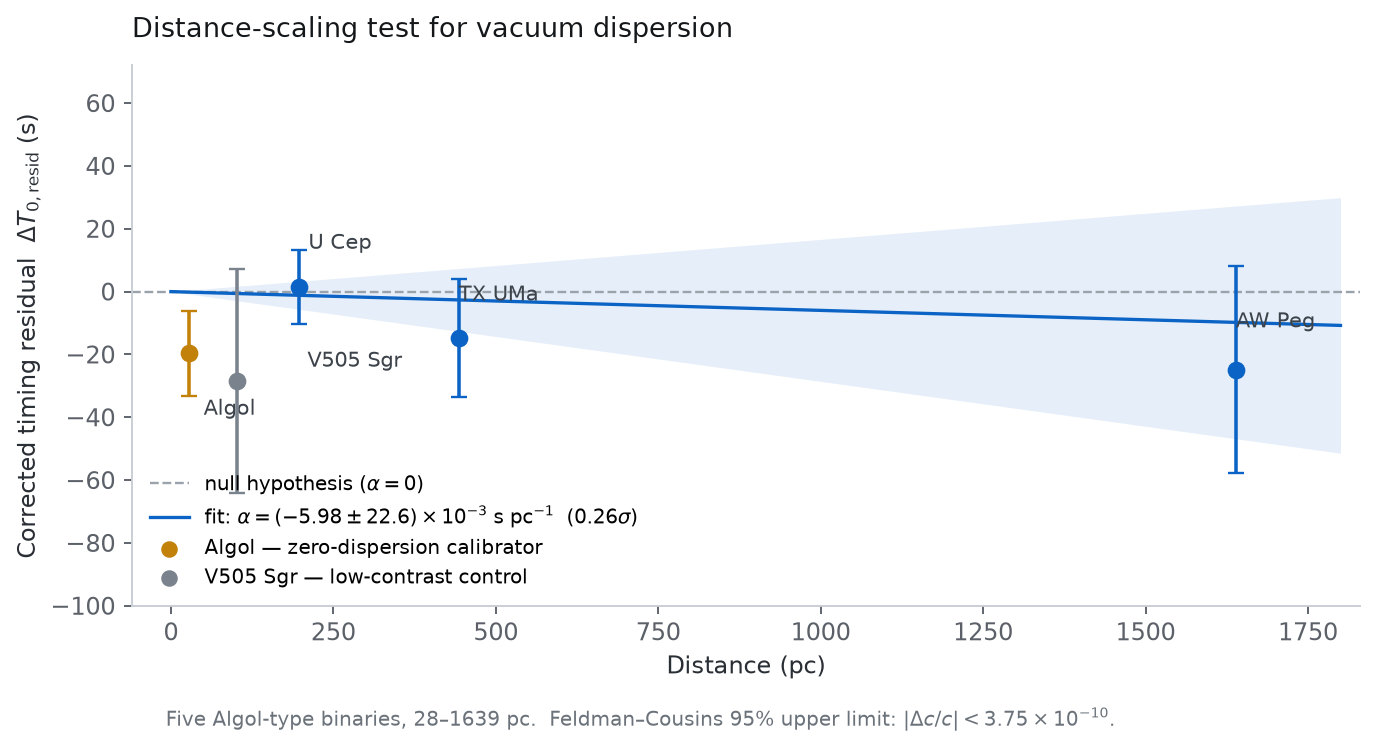
This is, to my knowledge, the first purely optical-wavelength measurement of vacuum dispersion — a constraint on the difference in propagation speed between 440 nm and 800 nm photons over 28–1639 pc. It improves on the optical-to-radio Crab pulsar result of Warner & Nather (1969) by a factor of about 1066 within the optical window.
It is also about eight orders of magnitude weaker than the Fermi-LAT gamma-ray bounds when both are expressed as |Δc/c| in the standard En parametrization. That comparison is not like-for-like — GeV photons carry an enormous energy lever arm, and a dispersion relation with structure in the eV regime would not necessarily show up at GeV energies — but the gap is real and this page states it rather than burying it. The contribution here is filling the optical portion of the multi-wavelength coverage, with a method that scales.
How it works
If the speed of light depends on frequency, photons of different colours emitted simultaneously from a stellar surface arrive at Earth separated by a delay proportional to distance: ΔTdisp = (d / c²) · Δc, where Δc is the difference in speed between the B (440 nm) and I (800 nm) bands.
Eclipsing binaries suit this well. The same geometric event recurs every orbital period, so timing can be averaged over epochs. The signal scales with distance, which gives a discriminant against any distance-independent systematic. And the dominant astrophysical foreground is predictable.
That foreground is limb darkening. Because stars are darker at the limb than at the centre, and more so at shorter wavelengths, the eclipse ingress has a different shape in B than in I — producing an apparent inter-band timing offset of order 20–50 s even with no new physics whatsoever. The measured offset is the sum of that astrophysical term and any dispersive term. The chromatic correction models the first with quadratic limb-darkening coefficients and subtracts it, leaving a residual that is regressed against distance.
Sample
| Target | Distance (pc) | Spectral types | Corrected residual (s) | Role |
|---|---|---|---|---|
| Algol (β Per) | 28.5 ± 0.7 | B8V+K0IV | −19.65 ± 13.59 | Calibrator |
| V505 Sgr | 101 ± 2 | F5V+F5V | −28.42 ± 35.67 | Low-contrast control |
| U Cep | 197 ± 5 | B7V+G8III-IV | 1.58 ± 11.80 | Science |
| TX UMa | 443 ± 10 | B8V+G0III-IV | −14.88 ± 18.77 | Science |
| AW Peg | 1639 ± 80 | B4V+F2III | −24.91 ± 32.92 | Science |
| RZ Cas | 178 ± 3 | A3V+K0IV | — | Excluded: MCMC non-convergence |
RZ Cas is shown because it was in the initial sample and was excluded: its MCMC walkers failed to converge to the correct orbital phase, producing an anomalous offset indicative of phase aliasing. Reporting it is part of the result.
Systematic error budget
| Source | σ(Δc/c) | Fraction of variance | Method |
|---|---|---|---|
| Limb darkening model uncertainty | 2.60 × 10⁻¹¹ | 1.37% | Algol calibrator residual floor |
| Distance uncertainty | 1.65 × 10⁻¹¹ | 0.55% | Gaia DR3 parallax propagation |
| Atmospheric DCR | < 4.1 × 10⁻¹¹ | < 0.1% | Airmass-dependent model |
| Regression method (linmix vs BCES) | 4.33 × 10⁻¹² | — | Cross-method comparison |
| CMOS nonlinearity | ≪ 10-11 | < 0.01% | Detector linearity characterization |
| Starspot variability | 0 | 0% | Single epoch — unassessed |
| Total systematic | 3.11 × 10⁻¹¹ | 2.0% | Quadrature sum |
| Statistical | 2.20 × 10⁻¹⁰ | 98.0% | linmix regression posterior |
A 98% statistical error budget is an unusually clean situation, and it is why this program is worth continuing. Sensitivity improves directly with aperture, number of targets, distance leverage, and as 1/√N with epochs — no new technique required. Extending to 5–10 kpc with 2–4 m telescopes is worth a factor of 3–6; a 2 m aperture alone reduces photon noise by about 4; southern-hemisphere sites would roughly double the available sample.
The polarimeter
The timing measurement tests dispersion — whether different colours travel at different speeds. A Lorentz-violating vacuum can also be birefringent, rotating the plane of linear polarization as light propagates. That is a distinct signature and timing cannot see it. The polarimetry channel is being built to measure it, looking for a position-angle rotation that grows with distance. The name is the programme: timing and polarimetry are two channels on the same question.
The binding difficulty is already known from CMB experience: an error in the instrument’s absolute polarization angle is exactly degenerate with a real rotation. Integration time does not separate them. Calibration does, which is why the instrument design is where the effort goes.
Literature review
A focused, source-verified review supporting the program. No constraint enters the evidence table unless checked against the original source; rows awaiting that check are visibly marked.
- Structured evidence table — every constraint with source, method, band, parametrization, assumptions, systematics, and reported bound.
- Known, uncertain, and new — a memo stating where the field is and what a new optical program contributes.
- Optical polarimetry methods and instrumental systematics — queued.
- Intrinsic polarization and variability in Algol-type binaries — queued; the astrophysical foreground for the polarimetric channel.
Paper
Constraining Vacuum Dispersion at Optical Wavelengths via Multi-Band Eclipsing Binary Timing
Brian Keating · 19 March 2026
BibTeX
@unpublished{keating2026dispersion, author = {Keating, Brian}, title = {Constraining Vacuum Dispersion at Optical Wavelengths via Multi-Band Eclipsing Binary Timing}, year = {2026}, note = {Draft}, url = {https://keating.ai/polite/} }
Record
Warner & Nather constrain |Δc/c| < 4 × 10⁻⁷ using Crab pulsar optical-vs-radio arrival times — the most-cited optical-adjacent result, but spanning optical to radio rather than within the optical window.
First purely optical-wavelength constraint on vacuum dispersion: |Δc/c| < 3.75 × 10⁻¹⁰ (95% CL) between 440 nm and 800 nm, from multi-band eclipse timing of five Algol-type binaries at 28–1639 pc.
Collaborate
The measurement is 98% statistics-limited. That is an unusually clean invitation: more aperture, more targets, more epochs translate directly into a better bound, and no new technique is required to improve on it.
- Small-telescope observers running multi-band eclipse timing — the method is distance-scalable and multi-epoch averaging goes as 1/√N
- Southern-hemisphere sites, which would roughly double the available target sample
- 2–4 m class time on targets at 5–10 kpc, worth a factor of 3–6 on the constraint
- Polarimetry instrumentalists — the birefringence channel needs absolute position-angle calibration at the 0.1° level
- SME and LIV theorists on non-power-law dispersion models that could evade GeV bounds while surviving at eV energies
If any of that is you, my university contact details are on my UC San Diego profile. Mention POLITE by name — it routes faster.

