A Drake-like factorization for life moving between worlds — and what Mars’s silence actually constrains.
Status: framework drafted; replacing point factors with source-backed distributions is the open work.
The equation
Λpan is the expected number of successful seeding events from a source world to a target world over a specified interval. The probability of at least one is P≥1 = 1 − exp(−Λpan).
The Drake equation did not solve the problem of extraterrestrial intelligence. Its enduring value was different: it organized ignorance. By separating star formation, planets, life, intelligence, technology, and longevity into distinct factors, it made disagreement inspectable.
Lithopanspermia needs the same discipline. The claim that life can travel inside rocks is often treated as if dynamical transfer settles the question. It does not. A rock can move from Earth to Mars without carrying life; life can survive launch without surviving radiation; viable cells can reach Mars without entering a wet habitat; and cells in a wet habitat may still fail to establish a persistent population. Each is a separate filter, and any one can dominate the answer.
The nine factors
| Symbol | Factor | Meaning | Status |
|---|---|---|---|
N_launch |
Launch opportunities | Biologically relevant launch events or units over the interval | astrophysical |
f_bio |
Biologically loaded | Fraction of launched material carrying viable or dormant organisms | speculative |
f_lowshock |
Low-shock launch | Fraction ejected under shock and heating compatible with survival | astrophysical |
f_transfer |
Reaching the target | Fraction arriving at the target world at all | astrophysical |
f_fast |
Fast arrival | Fraction arriving within biologically relevant survival timescales | astrophysical |
f_shield |
Shielded survival | Fraction protected against radiation, vacuum, desiccation, thermal stress | speculative |
f_entry |
Entry survival | Fraction surviving atmospheric entry, fragmentation, and deposition | astrophysical |
f_hab |
Habitable deposition | Fraction deposited into a habitable target environment | speculative |
f_founder |
Founder establishment | Probability the delivered inoculum exceeds ecological founder requirements | speculative |
These are not independent physical variables. Several are conditionally coupled through ejecta size, launch velocity, burial depth, transfer time, and entry state. The present form is an accounting scaffold; a mature version replaces the product of point factors with source-backed joint distributions.
Earth to Mars, worked
For a cell-count version, the expected number of viable source-world cells delivered to the target is V = Mtot · Crock · ftransfer · s, where s = flowshock ffast fshield fentry is the full-chain survival probability. With Mtot = 1013 kg of biologically loaded low-shock ejecta, Crock = 108 cells kg-1, ftransfer = 10-3, and s = 10-7, this gives V ≈ 1011 viable arrivals.
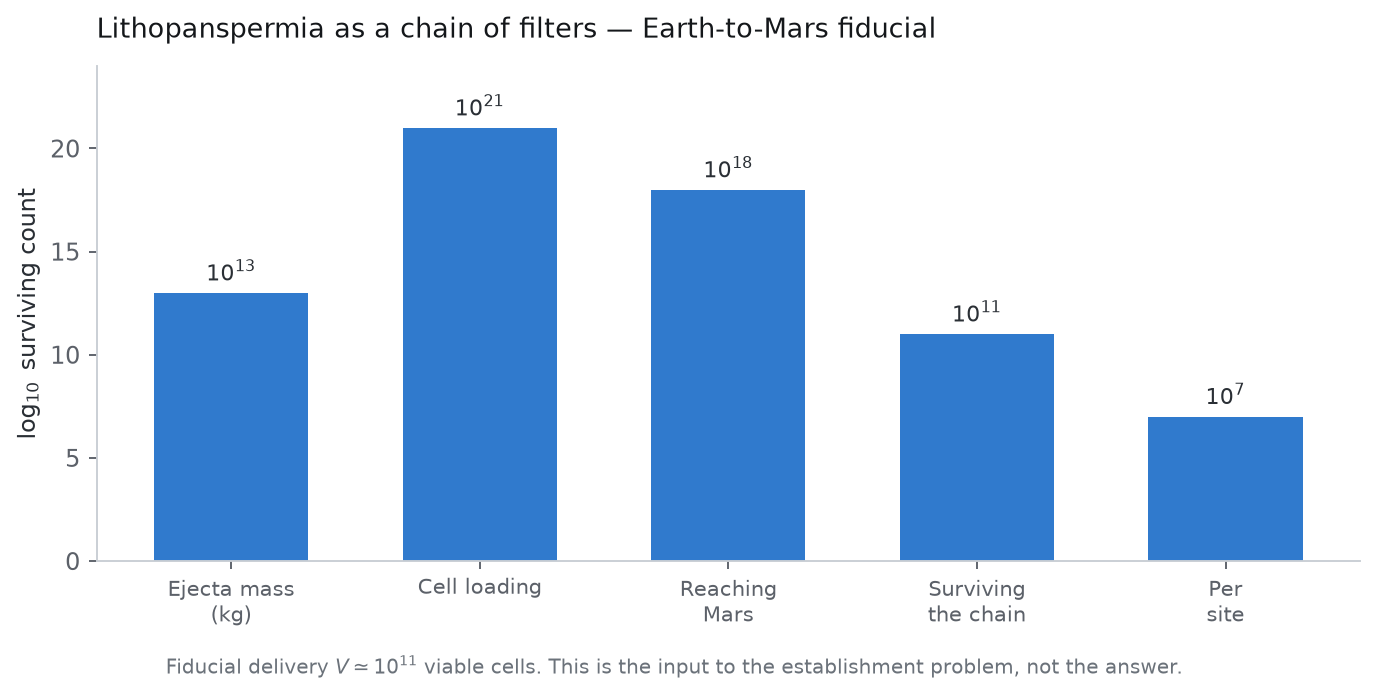
That number is not the answer. It is the input to the establishment problem, and it is emphatically not the probability that Mars has life. A large number of viable arrivals may still fail if they are spatially diluted, temporally mistimed, chemically incompatible, or below a founder threshold at any one site.
Delivery is not establishment
Establishment is modelled by treating arrivals at each of Reff effective colonization opportunities as Poisson with mean λ = V / Reff, and asking whether any site exceeds a founder threshold Nf. A fiducial delivery of 1011 cells is decisive for permissive thresholds and irrelevant for stringent ones — which is the point. The last factors in the chain are ecological, not physical.
Mars as a null experiment
The central use of the framework is not to infer the origin of terrestrial life. It is to ask what Mars should have looked like if Earth-to-Mars panspermia were a highly fecund process — and to treat the answer as data.
The phrase “lack of life on Mars” has to be used carefully. Mars has not been exhaustively searched, and recent results include organic molecules, habitable ancient settings, and possible biosignatures under active evaluation. The relevant observation is not proven sterility. It is the present absence of unambiguous evidence for extant life, extinct life, or technology.
ηbio is the probability that one successful seeding event leaves an observable trace today — persistence, burial, preservation, radiation damage, weathering, search coverage, instrument sensitivity, and interpretive ambiguity, all folded together. For α = 0.05 the bound is roughly 3/ηbio.
The bound is strong if ηbio is large and weak if preservation and detection are poor. That is precisely the point: erosion, fossil loss, oxidative weathering, burial, radiation damage, and limited search coverage do not invalidate the null argument, but they must appear explicitly in the denominator rather than being waved at.
This runs opposite to the cosmic-history argument of Frank & Sullivan, which uses the large number of habitable-zone planets over cosmic time to ask how rare technological species must be. That is a large-N abundance argument. This is a small-N local null experiment with unusually strong transfer priors — one nearby, dynamically coupled, partially searched world.
What this is not
It is not a claim that Earth seeded Mars, and not an alternative theory of abiogenesis. Equation-based astrobiology is useful only when it clarifies uncertainty rather than laundering it into false precision — the lesson of the Venus Life Equation and of the phosphine episode that followed it. High expert agreement that basic extraterrestrial life is likely somewhere does not justify a confident prior on any particular transfer route. The prior belongs on the model class; the posterior has to be earned by the factors.
Paper
Lithopanspermia: A Drake-Like Framework for Transfer, Survival, and Establishment
Brian Keating · 20 June 2026
BibTeX
@unpublished{keating2026litho, author = {Keating, Brian}, title = {Lithopanspermia: A Drake-Like Framework for Transfer, Survival, and Establishment}, year = {2026}, note = {Draft}, url = {https://keating.ai/keating-equation/} }
Collaborate
The equation is an accounting scaffold. Its value now depends entirely on replacing point factors with source-backed distributions — which is other people’s data, not mine.
- Impact-survival experimentalists — combined shock, shielding, radiation, desiccation, and entry-heating survival, not one filter at a time
- Mars geologists mapping long-lived wet environments as effective colonization opportunities
- Biosignature preservation modellers — the null argument lives or dies on ηbio
- Explicit search-completeness estimates for rover, orbiter, returned-sample, and subsurface detection
- Dynamicists working compact exoplanet systems, where the transfer kernel is far larger than Earth–Mars
Contact details are on my UC San Diego profile.


